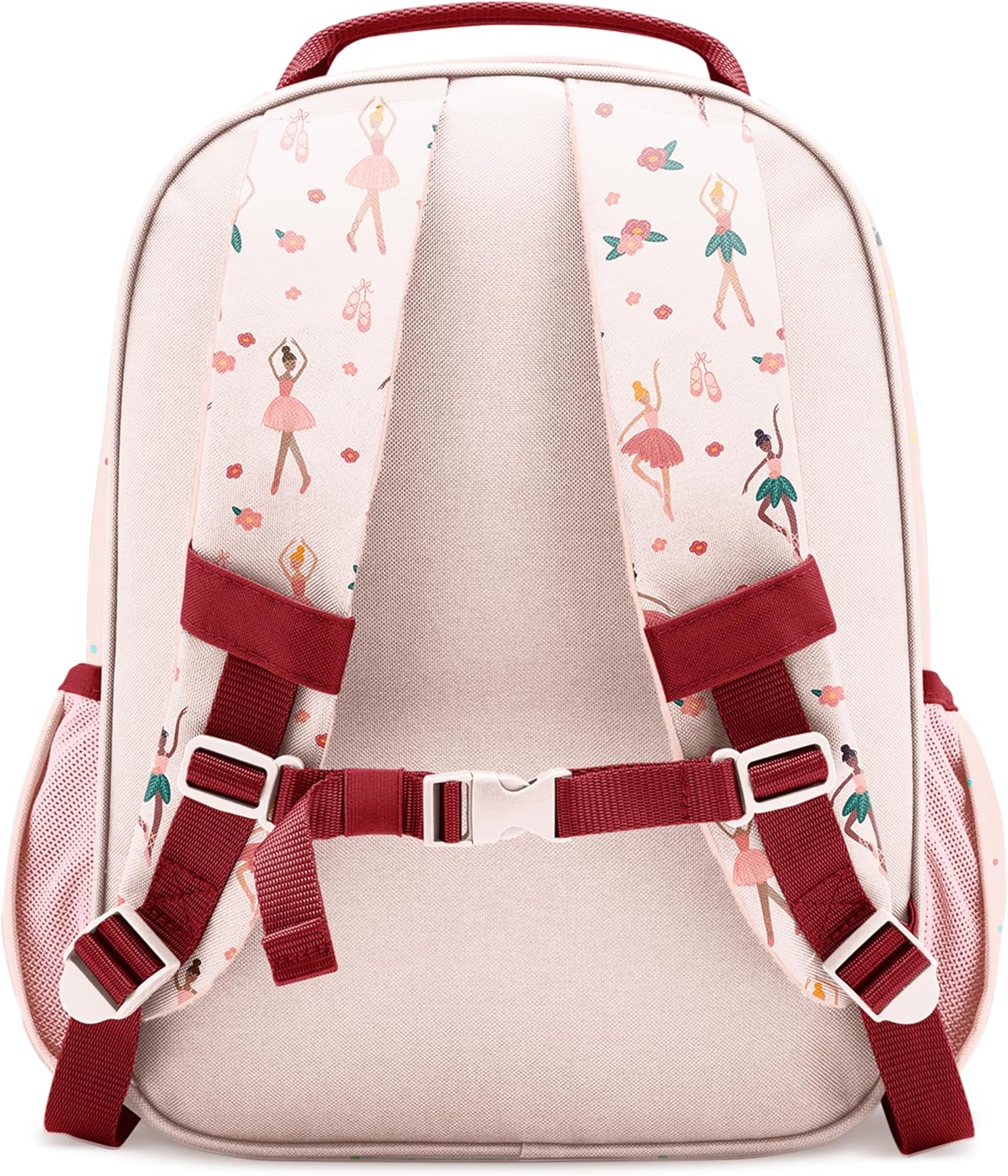
You’ve got the school’s supply list in one hand and a backpack listing in the other, and the numbers aren’t obviously helping. “12-liter capacity” sounds like it might be enough — but will an actual Mead Five Star plastic folder (the kind most kindergarten teachers require) lay flat inside without curling? Will there still be room for a lunch bag and a water bottle? These are the questions that matter at 7:45 a.m. on the first day of school, and they’re rarely answered in a product description.
This guide cuts straight to that question. We analyzed published specs, aggregated owner reviews from multiple retail channels, and documented sizing patterns across the most-recommended kindergarten backpacks at the $30–$100 price range. The goal: an honest decision frame so you can match the right bag to your kid’s actual school requirements before you click buy.
| EDITOR'S PICK[Simple Modern Medium Toddler Ba…](https://www.amazon.com/dp/B0F2GCBDJ6?tag=greenflower20-20) | Mid-tier[mommore Kids Backpack for Boys…](https://www.amazon.com/dp/B0B28J2S6N?tag=greenflower20-20) | Budget pickSkip Hop Sparks Kid's Backpack | |
|---|---|---|---|
| Height | 15" | 15" | — |
| Lunch box inc. | ✗ | ✓ | ✗ |
| Folder fits | — | ✓ | — |
| Price | $35.99 | $25.49 | $21.99 |
| See on Amazon → | See on Amazon → | See on Amazon → |
The Kindergarten Packing List Is Stricter Than You Think
Most kindergarten and first-grade teachers send home a supply list that includes at minimum:
- One standard composition notebook (9.75” × 7.5”) or a two-pocket folder (9.5” × 11.75”)
- A lunch bag or insulated lunch box — typically 8”–10” tall and 5”–7” wide
- A water bottle — most schools now require 16–24 oz, often stainless steel
That folder is the hidden villain of the sizing conversation. A standard two-pocket plastic folder is nearly 12 inches tall when unfolded and close to 10 inches wide. A backpack main compartment needs a gusset (the panel that creates depth) of at least 4 inches and a height clearance of at least 12 inches for the folder to slide in flat. Below that threshold, the folder bends, the pockets tear, and your five-year-old is handing the teacher a crumpled mess by September 15th.
The Wirecutter’s kids’ backpack guide (New York Times Company, 2025) flags this exact issue as the most common sizing mismatch in the kindergarten category, noting that bags marketed as “toddler to kindergarten” often max out at 10–11 inches of interior height — which works for a library book but not for a school folder.
By the Numbers: Minimum Specs That Actually Work
| Dimension | Minimum for a Folder to Lie Flat | Sweet Spot |
|---|---|---|
| Interior height | 12 inches | 13–14 inches |
| Interior gusset depth | 4 inches | 5–6 inches |
| Overall bag volume | 12 liters | 15–18 liters |
| Exterior water bottle pocket | 3-inch opening | 3.5–4 inches |
These numbers come from cross-referencing published spec sheets against the standard folder dimensions above. A bag that hits the “sweet spot” column can carry a folder, a slim lunch bag, a water bottle, and a lightweight layer — without looking comically oversized on a 40-pound child.
How the Most-Recommended Bags Actually Compare
Here’s where the practitioner layer matters: knowing a bag is “popular” is less useful than knowing which dimension it tends to shortchange and how that trades off at each price point.
Under $40: The Character-Print Tier
The JanSport SuperBreak Jr. (approximately $35–$40, widely stocked at Target, Walmart, and direct via JanSport’s site) is the volume leader in this category. Published specs put it at 25 liters — which sounds generous — but owners on multiple retail review aggregates consistently note the single main compartment is deep and tall but only moderately wide, which means the folder fits but the lunch bag competes for the same space. There is no dedicated lunch compartment. The water bottle pocket on the Jr. runs about 3.5 inches wide, which accommodates most standard bottles but can be tight on wide-mouth 24 oz. stainless options.
The Pottery Barn Kids Classic Backpack (Mini, approximately $49.50 before monogram) is frequently cited as the entry point to the brand. Per the published spec on the Pottery Barn Kids site, the Mini measures 12”H × 10”W × 5”D — right at the folder-clearance threshold. Owners of kindergarteners consistently report it works for folders but feels genuinely full with a lunch bag added, making it better suited for a child whose school provides lunch or who carries a very slim insulated pouch rather than a structured bento box.
Good Housekeeping’s 2025 kids’ backpack roundup notes that most packs in the sub-$40 tier were designed with “day trip” or “toddler errand” use cases in mind, and that folder clearance is the dimension most frequently sacrificed to keep the silhouette from overwhelming small frames.
The $40–$80 Workhorse Tier
This is where the folder-plus-lunch-plus-bottle equation starts to solve more reliably — but the tradeoffs shift from capacity to organization.
The Herschel Supply Little America Kids (approximately $65–$75 at L.L.Bean, Nordstrom, and directly at herschel.com) is one of the most consistently recommended bags in this range. Published dimensions put it at 17 liters with a main compartment measuring roughly 14”H × 10.5”W × 5”D. That height clears the standard folder with room to spare. Owners report the dual-zip main compartment keeps snacks and folders from co-mingling, and the exterior stretch pocket handles most water bottles securely. The tradeoff, per aggregated reviews at Parents.com (2025), is that the shoulder straps are fixed-length, which means sizing must be matched to the child’s torso height in year one — it does not grow with them across multiple school years the way an adjustable-strap pack does.
The L.L.Bean Kids’ Original Book Pack (approximately $34.95–$39.95 at llbean.com) punches above its price tier on capacity. Published specs list 1,500 cubic inches (approximately 24.6 liters), with a tall main compartment that owners consistently say swallows a folder, a lunch bag, and a water bottle without drama. The exterior zip pocket and side water bottle pockets are widely praised in reviews for being accessible to small hands without requiring a parent to unzip the main compartment at pickup. BabyGearLab’s 2025 analysis of carry-on and school-age bags flags the L.L.Bean Book Pack as a notable outlier for per-dollar organizational value at this price point. The aesthetic is intentionally unfussy — solid colors, embroiderable name patch, no licensed characters — which either reads as “timeless” or “boring” depending on your five-year-old’s opinions.
The Lands’ End ClassMate Large Backpack (approximately $49.95–$54.95 at landsend.com) is the dimension champion in the mid-range tier. Published specs list a main compartment of 14”H × 11”W × 6”D — one of the widest gussets in the category, which means the lunch bag sits beside the folder rather than on top of it. Owners specifically call out that it handles a structured bento-style lunch box (as opposed to a soft insulated bag) better than most competitors. The tradeoff: it runs large, and on petite kindergarteners it can look like the bag is wearing the child. Parents.com’s 2025 guide recommends it for kids on the taller end of the kindergarten range and as a bag intended to carry through second or third grade.
$80 and Up: The Keepsake and Premium Tier
Above $80, the purchase logic shifts. You’re not primarily buying for better folder clearance — the mid-range bags already solve that. You’re buying for longevity, personalization, or a specific aesthetic that matters to your family.
The Pottery Barn Kids Mackenzie Large Backpack (approximately $79.50–$89.50 before monogram, at potterybarnkids.com) is the most gift-purchased bag in this category and one of the most embroidered products in the children’s accessories market. Published specs put the Large at 17”H × 12”W × 6”D — the folder fits, the lunch bag fits, the water bottle pocket is rated for most standard sizes. Reviewers at multiple outlets consistently note the stitching holds through multiple years and multiple children, which makes the per-year cost math competitive with mid-range bags that need replacing annually. The monogram lead time through Pottery Barn Kids runs 2–3 weeks in normal windows and 4–6 weeks during July–August and November–December peaks — if you’re buying for a September start or a December birthday, order before mid-July or mid-November respectively.
The Decision Frame: If X, Then Y
You’ve absorbed the specs. Here’s how to convert that into a choice without second-guessing it at checkout.
If your school requires a full-size plastic folder AND a structured lunch box AND a 24 oz. water bottle: Go to the 15-liter-and-above tier with a gusset of at least 5 inches. The Lands’ End ClassMate Large or L.L.Bean Book Pack are the strongest calls here. The Herschel Little America Kids works if the lunch bag is slim.
If your school provides lunch and your child only carries a folder, snack, and water bottle: The Pottery Barn Kids Classic Mini or any character-print bag in the 12–15 liter range is genuinely sufficient. Don’t pay for volume you won’t use.
If the bag is a milestone gift — first day of school, grandparent giving, monogram moment: The Pottery Barn Kids Mackenzie Large is the default answer. The personalization is the product; the capacity happens to be solid too. Order early. The embroidery waitlist fills fast every August.
If your child is petite (under 38 inches) and the bag needs to last one year only: Prioritize weight-empty over volume. A 12-liter bag that weighs 8 oz. empty is kinder to a small spine than a 17-liter bag that weighs 1.5 lbs. before a single folder goes in. BabyGearLab’s 2025 research consistently flags empty-bag weight as an underweighted variable in parents’ purchase decisions for the kindergarten-to-first-grade window.
If the aesthetic matters as much as the function: That’s a legitimate variable, not a shallow one. A bag a child is excited to carry gets carried. A bag they’re embarrassed by gets “forgotten” at school pickup. The character-print tier exists for a reason. Just confirm the folder clears before you commit.
The folder test is the simplest thing you can do before buying. Find a standard two-pocket folder in your house, note its dimensions, and match them against the main compartment spec of the bag you’re considering. If the bag’s listed interior height is 12 inches or more and the gusset is 4 inches or more, you’re clear. If the listing doesn’t publish interior dimensions — which is common in the character-print and budget tier — that’s information too. Reach out to the retailer directly, or default to a brand that publishes the numbers.
The right kindergarten backpack doesn’t need to be expensive. It needs to fit the folder flat, hold the lunch bag without a fight, and survive a year of being dropped on a coat-room floor. Everything above that threshold is preference — and preference is worth having.