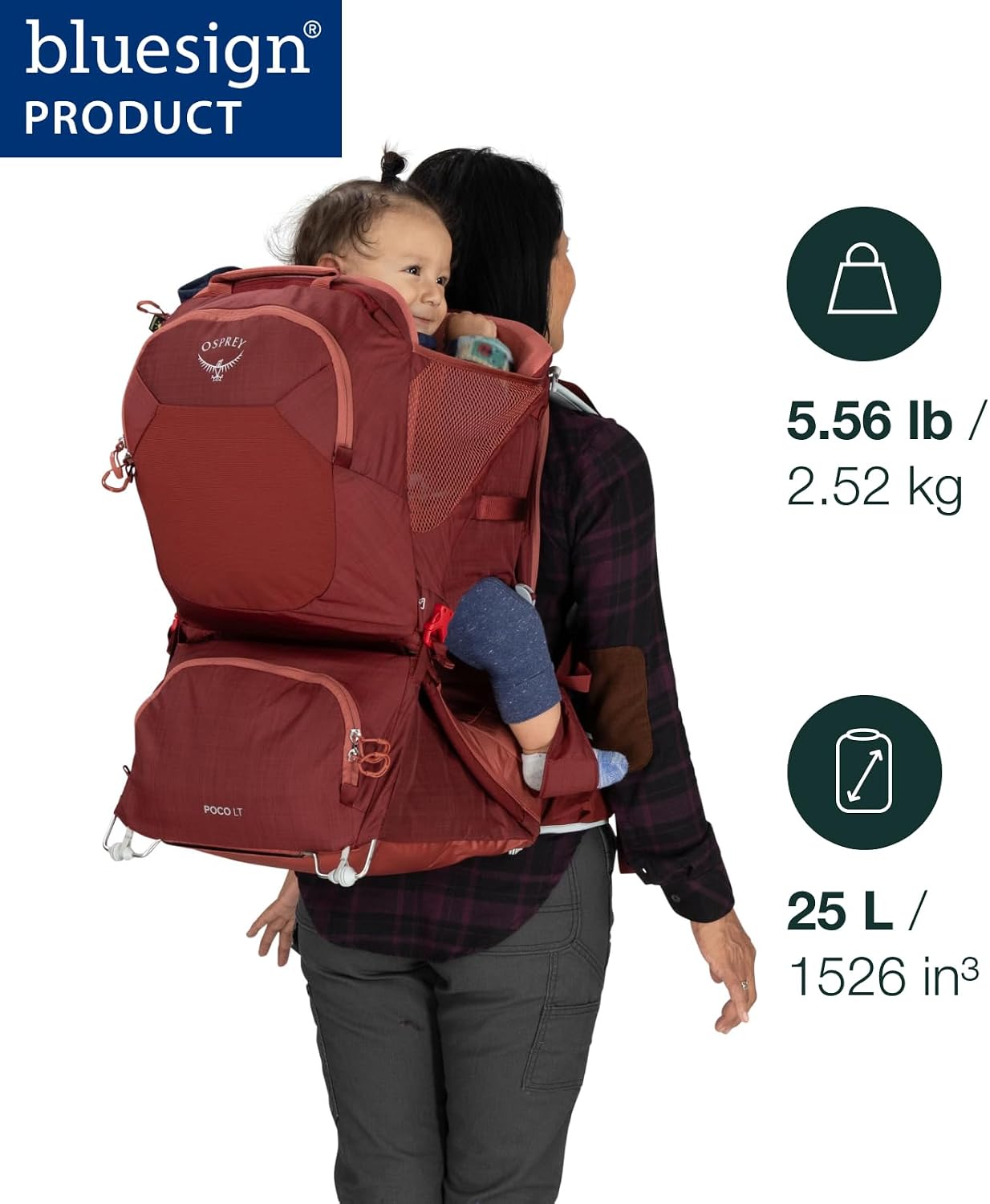
You’re looking at a $250 backpack that holds your toddler on your back while you hike. It feels like a lot. And honestly, before you commit, there are a handful of real tradeoffs that most product pages gloss over. This guide is for the parent who has already decided they want to hike with a small child — you just want to spend the money once and on the right thing.
A child carrier backpack (sometimes called a “frame carrier” or “hiking carrier”) is not the same as the soft structured carriers you used for newborn cuddles. Those are worn low on the chest and designed for infants. A frame carrier has a rigid aluminum or composite frame, a raised cockpit seat for your child, and a suspension system — basically, a small hiking pack that replaces your backpack while keeping a toddler on your back. Most models are rated for children roughly 6 months old through 48 pounds, though the realistic useful window for most families is 12 months through 3.5 to 4 years. After that, most kids just walk.
| EDITOR'S PICK[Deuter Kid Comfort Child Carrie…](https://www.amazon.com/dp/B08FF8ZSXB?tag=greenflower20-20) | Mid-tier[Osprey Poco LT Lightweight Chil…](https://www.amazon.com/dp/B0D6GVY8YQ?tag=greenflower20-20) | Budget pick[besrey Baby Backpack Carrier](https://www.amazon.com/dp/B0BZC1VKKQ?tag=greenflower20-20) | |
|---|---|---|---|
| Sunshade | — | ✓ | — |
| Adjustable Seat | — | — | ✓ |
| Foldable Frame | — | — | ✓ |
| Price | $299.99 | $224.95 | $135.99 |
| See on Amazon → | See on Amazon → | See on Amazon → |
The One Decision That Determines Everything Else: Torso Fit vs. Weight Capacity
Most buyers anchor on weight capacity first. That’s the wrong variable to lead with.
The frame carrier’s suspension transfers child weight to your hip belt, exactly like a hiking pack. If the torso length — the distance from your hip shelf to your shoulder — doesn’t match the carrier’s adjustable range, you’ll carry the load wrong, and no amount of padding fixes that. Per BabyGearLab’s child carrier backpack reviews, improper torso fit is the most common cause of parent back pain on the trail, and it’s entirely avoidable if you measure before you buy.
How to measure your torso length: Stand straight. Find your C7 vertebra — the bony bump at the base of your neck. Find your iliac crest — the top edge of your hip bone. The distance in inches between those two points is your torso length. Most adult carriers adjust somewhere between 15 and 21 inches. Carriers like the Osprey Poco series and the Deuter Kid Comfort series each offer two or three separate frame sizes, and some models feature a continuous adjustment dial that handles a wider range on a single frame.
Here’s the tradeoff this creates:
- If you and your co-parent have significantly different torso lengths (say, 16” and 20”), a single carrier will likely fit one of you correctly and the other poorly. Wirecutter’s updated 2025 guide on hiking baby carriers specifically flags this as the reason some families end up owning two carriers — or buying the Osprey Poco Plus, which has the widest adjustment range in its class.
- If you share a similar torso length, you can optimize for other variables: child cockpit features, pack volume, and weight.
Don’t skip this step. It’s the one that makes or breaks the investment.
What the Price Tiers Actually Buy You
Here’s where the math starts to matter.
By the numbers
| Price range | What you’re paying for | Typical total carry weight (child + gear) |
|---|---|---|
| $120–$160 | Basic frame, hip belt, sunshade sold separately | 40–45 lbs rated |
| $180–$260 | Integrated sunshade, better suspension, more pack volume | 48–50 lbs rated |
| $280–$380 | Full-featured suspension, built-in hydration, kickstand, sternum strap mirrors | 50+ lbs rated |
The jump from entry-level to mid-tier ($160 to $220 range) is where owners most consistently report a meaningful comfort difference on hikes over two miles. The jump from mid-tier to premium (above $280) is more situational — it buys you convenience features (integrated rain cover, hydration sleeve, child’s snack tray) rather than a fundamentally different carry experience on moderate trails.
Per Outside Online’s 2024 carrier guide, the Osprey Poco series and the Deuter Kid Comfort series are the two most consistently recommended mid-to-premium options across multiple review cycles. Both have been refined over many generations and have large communities of long-term owners whose feedback has shaped recent updates.
The honest case for spending at the top of the range: If you hike regularly — more than 20 outings per season — the per-use cost math favors the premium tier. A $300 carrier over 80 hikes is $3.75 per use. The same math applied to a $160 entry-level carrier that you replace at the two-year mark because it’s uncomfortable costs more in the long run. Parents.com’s 2025 roundup notes that resale value is also meaningfully better on Osprey and Deuter carriers, which hold 40–60% of original value on the secondary market when they’re kept clean and stored flat.
The honest case for NOT spending at the top: If you’re a once-or-twice-a-summer hiker, a $160 carrier does the job. The cockpit is safe. The child is secure. You’re just carrying a bit more effort per mile.
The Features That Sound Important but Rarely Matter (and the Ones That Do)
After reviewing aggregated feedback across BabyGearLab, Wirecutter, and Parents.com, a consistent pattern emerges about which features drive long-term owner satisfaction versus which ones read well in marketing copy but rarely get used.
Features that consistently matter:
Kickstand. A wide, sturdy kickstand lets you set the carrier down on the trail while the child is still seated. This sounds minor. On a four-mile hike when your toddler is 35 pounds, it is not minor. Owners in long-run reviews describe it as the feature they’d never give up. Entry-level carriers often omit it or include a flimsy version that doesn’t hold on uneven ground.
Integrated sunshade. Toddlers face backward in these carriers. They can’t move out of direct sun. An integrated sunshade (not a clip-on accessory sold separately) stays in place when you turn your head, doesn’t catch wind the way clip-ons do, and doesn’t require an extra $30–$50 purchase. BabyGearLab consistently marks this as a high-weight safety feature, not just a convenience.
Adjustable child cockpit height. Your toddler at 18 months is not the same torso height as your toddler at 3 years. Carriers with a height-adjustable seat can grow with the child across the full useful window. Wirecutter’s 2025 guide identifies this as a key differentiator between single-season and multi-season value.
Hip belt pockets. You need to reach snacks, a phone, sunscreen without taking the pack off. Hip belt pockets that are big enough to actually hold these items (not vestigial zip pockets) show up in nearly every positive long-run owner review as a comfort-of-use feature.
Features that sound important but rarely move the needle:
Total pack volume above 25L. Most families hiking with a toddler carry water, snacks, a diaper kit, and a layer. That’s 10–15L of actual gear. The difference between a 22L and a 30L carrier matters only if you’re doing overnight trips — a genuinely niche use case for most buyers at this stage.
Integrated rain cover. Nice to have. But many owners report that by the time rain is heavy enough to need it, the hike is over. Sold-separately rain covers cost $20–$35 and weigh almost nothing. It’s not a strong reason to move up a price tier.
Hydration sleeve. Useful on hot trails. But it’s present on most mid-tier and above carriers anyway. Not a differentiating feature at the margin.
The Age-and-Weight Window: Don’t Overspend for a Window You’ve Already Missed
This is the most underappreciated variable in the buying decision.
Most manufacturers rate frame carriers starting at 6 months (when a child has neck control) through 48 lbs. But Outside Online’s 2024 guide points out that the practical upper limit is less about weight and more about whether your specific child will tolerate being in a seat on your back. Many children become unwilling passengers between ages 3 and 4, regardless of weight.
If your child is already 2.5 years old, the full-price premium carrier math weakens. You likely have 12–18 months of useful carry life, not 3 years. In this scenario, a well-fitted mid-tier carrier at $160–$200 makes more sense than the $300 flagship. The per-use cost at 12–18 months of use doesn’t justify the premium.
If your child is 10–14 months and you hike regularly, this is where the premium tier genuinely earns its cost. You have potentially 2.5–3 years of use ahead. The suspension quality and adjustability pay dividends across that window.
The Decision Rule
After working through the fit, price tier, and age-window variables, here’s the framework that resolves most decisions:
If X, then Y:
-
You hike more than 15 times per season AND your child is under 18 months → Buy the best-fitting carrier in the $220–$300 range. Prioritize torso fit and kickstand. Osprey Poco Plus and Deuter Kid Comfort series are the names that appear most consistently in long-run owner reviews at this tier.
-
You hike occasionally (fewer than 10 times per season) OR your child is already 2+ years old → A mid-range carrier at $150–$200 is the right call. Spend the savings on trail gear or a good rain layer for yourself.
-
You and your co-parent have torso lengths more than 3 inches apart → Either buy two separate carriers or prioritize a model with the widest published adjustment range. A carrier fitted to only one of you will sit in the closet on the days the other parent wants to hike.
-
You’re buying as a gift → Stick to a gift card from a specialty outdoor retailer and include a note that torso fit matters. The recipient needs to try it on before committing. This is not a category where surprise purchases usually land well.
One more thing worth knowing: these carriers aren’t typically sold at big-box baby retailers. REI, specialty outdoor shops, and direct manufacturer sites carry the full range and — critically — staff who can measure your torso and help you fit the carrier in-store. That fitting appointment is worth more than any spec comparison you’ll read online, including this one.
Sources: BabyGearLab, Child Carrier Backpack Reviews and Ratings, 2025 edition; Wirecutter (New York Times), The Best Baby Carrier for Hiking, updated 2025; Outside Online, How to Choose a Child Carrier, 2024; Parents.com, Best Hiking Backpacks for Toddlers, 2025.