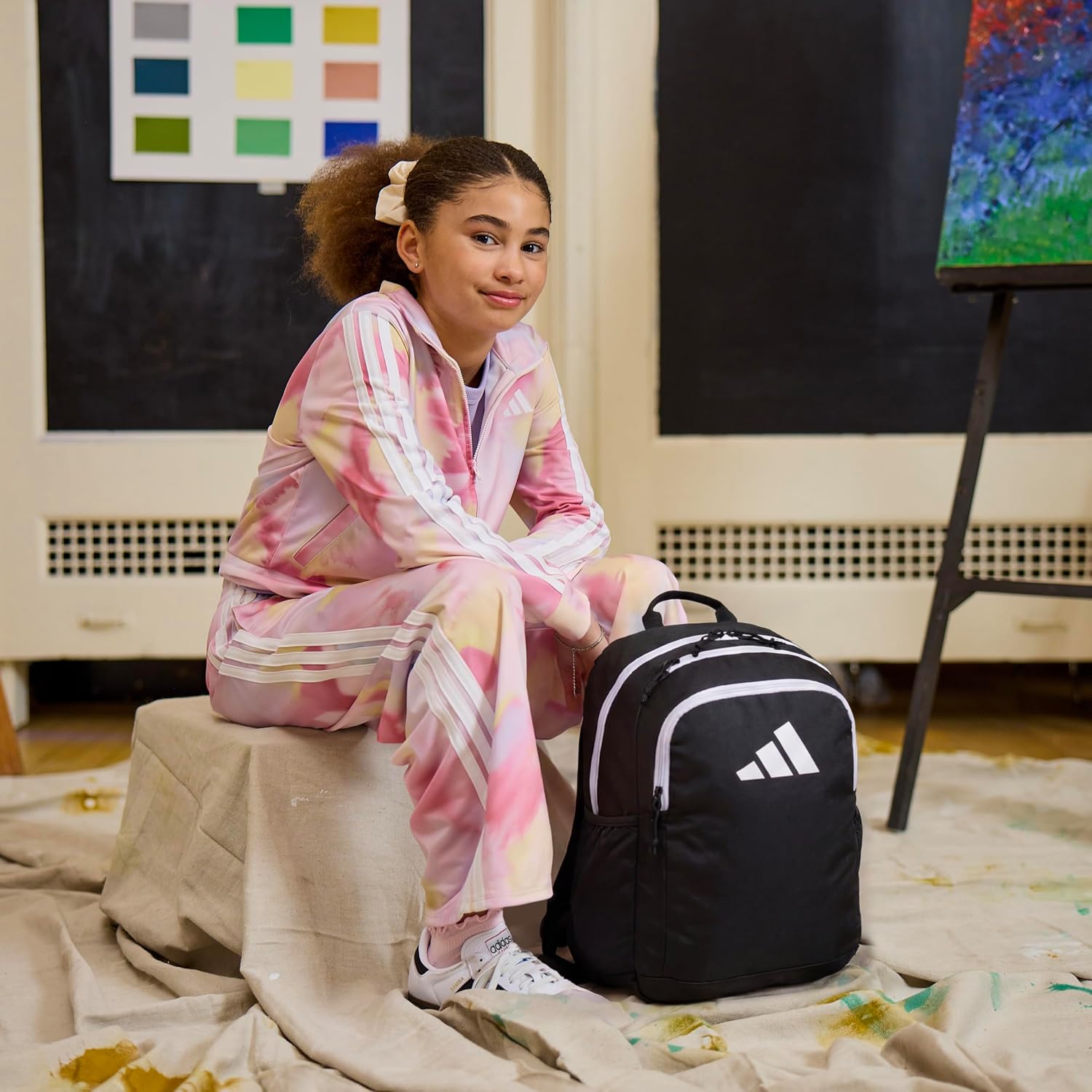
You bought the matching lunch bag last fall — and spent the whole year watching it slowly outlast the off-brand backpack you grabbed on the same Target run. That mismatch is exactly why “school sets” (a coordinated backpack and insulated lunch bag designed and sold together, often by the same brand in the same colorway or pattern) have become such a strong value proposition. You’re not paying extra for aesthetics. You’re buying a pair that wears at the same rate, fits the same organizational philosophy, and — when it’s time to replace — replaces together.
adidas sits at an interesting price point in this category: not the $12 grocery-store impulse buy, and not the $90 Pottery Barn Kids heirloom. Most adidas kids’ school sets land in the $40–$70 range for the pair, which puts them squarely in the mid-tier workhorse zone — the segment where durability-per-dollar is the real deciding factor. If you’re choosing between two or three sets right now, here’s the framework that will help you make the right call.
| EDITOR'S PICK[adidas Creator School Backpack](https://www.amazon.com/dp/B0CHH46VXD?tag=greenflower20-20)… | Mid-tier[adidas Kids Affiliate Backpack](https://www.amazon.com/dp/B0DGYZWGYN?tag=greenflower20-20)… | Budget pick[adidas Kids Santiago Lunch Bag](https://www.amazon.com/dp/B0DGWQC95Z?tag=greenflower20-20)… | |
|---|---|---|---|
| Type | Backpack | Backpack | Lunch bag |
| Capacity | — | 27L | 8L |
| Color | Gradient Rose Tone Pink/Onix Grey | Essential Camo Black/Orange | Adi Heart Melange Chalk White/Bliss Pink |
| Size | OSFA | OSFA | One Size |
| Price | $30.21 | $28.49 | $14.50 |
| See on Amazon → | See on Amazon → | See on Amazon → |
What You’re Actually Comparing in an adidas Set
When parents talk about adidas kids’ sets, they’re typically looking at two product families: the Spreadsheet and Excel lines for younger kids (roughly pre-K through second grade), and the Classic and Sport silhouettes that scale up through middle school. Each family has its own capacity, organizational layout, and strap system. Getting this wrong is the most common sourcing mistake.
By the numbers — adidas kids’ backpack capacity tiers:
| Age Range | Backpack Capacity | Typical Set Price |
|---|---|---|
| Pre-K–1st grade | 12–16 L | $35–$50 |
| 2nd–5th grade | 20–24 L | $45–$65 |
| 5th–8th grade | 28–32 L | $55–$75 |
Wirecutter’s backpack guide (The New York Times) notes that kids in grades K–2 are best served by bags under 16 liters — anything larger shifts weight awkwardly on smaller frames and tends to get overpacked. adidas’s smaller sets respect that constraint; the larger Classic 3-Stripe sets do not automatically shrink just because they’re marketed as “kids’.”
The lunch bag in a matched set is almost always a semi-rigid insulated tote — meaning it has foam or foil insulation sewn into the walls (not just a thin liner), a zipper closure, and a carrying loop or short strap. adidas lunch bags in their sets typically run 4–6 liters, which is appropriate for a sandwich container, a side snack, and a small ice pack. Parents reviewing these sets consistently note the insulation holds temperature reasonably well through a school morning, though neither adidas nor independent reviewers claim all-day cold retention comparable to a hard-shell lunch box.
The Three Variables That Actually Determine Fit
If you’ve looked at two adidas sets and can’t decide, you’re probably hung up on color or price. The variables that will matter in March, when you’re not thinking about the purchase anymore, are these:
1. Strap system and chest clip
Consumer Reports’ backpack buying guide consistently flags padded, adjustable shoulder straps with a sternum (chest) clip as a non-negotiable for kids carrying more than about 5 pounds. adidas sets in the Classic and Sport tiers include padded straps and an adjustable sternum clip. The entry-level Spreadsheet sets often omit padding and the clip. If your child is carrying a Chromebook, a water bottle, and a full lunch, the padded + clip setup is worth the extra $10–$15.
2. Main compartment organization
adidas backpacks in the mid-size range (20–24 L) typically offer one large main compartment and a front zip pocket. That’s it. No interior laptop sleeve, no key clip, no mesh organizer panels. Good Housekeeping’s kids’ backpack review notes this is actually a feature for younger elementary students — fewer zipper pockets means fewer things to lose and fewer broken zippers over the year. But if your fourth- or fifth-grader is managing folders, a library book, a device, and a planner, the single-compartment layout becomes genuinely frustrating by November. At that point you’re looking at the larger Sport sets with a secondary zip compartment, or accepting that organization will come from what goes inside the bag, not from the bag’s structure.
3. Material weight and water resistance
adidas uses a polyester-based fabric across most of its kids’ line. Published specs put the main body fabric at 600D polyester on the Classic sets — a density rating (D = denier) that indicates a medium-weight fabric, durable enough for daily school use but not waterproof. Owners consistently report it handles a light rain without soaking through immediately, but a sustained downpour will wet the contents. If your child walks to school or waits at an exposed bus stop, a DWR (durable water repellent) spray treatment — applied at home — extends the bag’s weather resistance meaningfully. This is not unique to adidas; Wirecutter makes the same note about most polyester kids’ bags in this price range.
Set vs. Separates: The Trade-Off to Name Explicitly
Here’s where practitioners sometimes miss the play: buying a coordinated set is not always better value than buying the backpack and lunch bag separately.
When the set wins:
- You want visual coordination (matching colorway, same logo treatment) and you’re not willing to mix-match.
- The set price is $5–$15 cheaper than buying the two pieces individually — which is usually true on adidas sets sold through Dick’s Sporting Goods, adidas.com, and Amazon.
- You’re buying for a younger child (pre-K through 2nd grade) where the lunch bag dimensions are calibrated to the backpack size.
When separates win:
- Your child has outgrown the lunch bag but not the backpack (or vice versa). Replacing a $20 lunch bag mid-year is a much easier decision than replacing a $65 set.
- You want a hard-shell lunch box for better insulation or durability — adidas sets pair with soft-sided lunch bags, so a Yeti or OmieBox-style container won’t be “matched” anyway.
- You’re buying at different times (backpack in August, lunch bag as a replacement in January) and set availability is limited.
Parents reviewing adidas sets on major retail sites frequently note that the lunch bag shows wear — zipper pull fraying, insulation compressing — before the backpack does. That’s a design reality, not a defect. The backpack fabric and structure are built to a higher durability standard than the lunch bag, which takes more physical abuse (dropped, stuffed into cubbies, wiped down daily). Planning for a mid-year lunch bag replacement is a reasonable strategy even when you start with a matched set.
Age-by-Age Decision Framework
Pre-K and Kindergarten (ages 3–6): Look at the adidas small-format sets — typically the 12–14 L backpacks paired with a simple insulated tote. The backpack needs to fit in a cubby, not a locker, so slim profile matters more than capacity. Owners of these sets consistently note the zippers are sized for small hands, which sounds minor but makes a real difference in a 4-year-old’s daily independence. Our read: the value is strong here, and the $35–$45 set price is well-matched to the replacement cycle (kids grow fast; you’re likely buying again in 18 months).
Grades 1–4 (ages 6–10): This is adidas’s sweet spot. The 20–22 L Classic sets are genuinely well-reviewed for durability at this age and load level. Parents.com’s lunch box guide notes that kids in this range need an insulated bag large enough for a full lunch plus a freezer pack — adidas sets in this tier accommodate that comfortably. The strap padding becomes important by second grade, when loads include heavier books and devices. Prioritize the sets with the sternum clip.
Grades 5–8 (ages 10–14): This is where adidas starts to face more competition from Herschel Supply and L.L.Bean, both of which offer larger-capacity bags with better interior organization at comparable price points. adidas’s Sport and Training sets in the 28–32 L range are popular with athletic kids (the brand recognition matters socially), but reviewers consistently note the organizational layout is sparse for a student managing multiple subjects. If the child is heavily involved in sports and will use the backpack double-duty for practice gear, adidas’s brand positioning actually fits the use case. If they’re primarily a student, a Herschel or L.L.Bean set may serve better.
Timing and Where to Buy
adidas releases new colorways in late July for back-to-school. That’s the window with the widest selection — if you want a specific color combination, buying in early August beats waiting. By mid-September, popular patterns in youth sizes are often sold out.
For the best selection, check adidas.com directly first — they carry the full colorway range and regularly run 20–30% site-wide promotions in back-to-school season. Dick’s Sporting Goods carries a reliable mid-range selection in-store, which matters if you want your child to try the strap fit before buying. Amazon carries most sets as well, typically at comparable prices, with faster shipping windows that become useful when you’re buying close to the first day of school.
Monogramming or personalization isn’t offered by adidas directly. If a custom name or initial matters for your family — particularly useful for preventing mix-ups in younger grades — plan to have it done through a local embroidery shop or an Etsy monogramming seller after purchase. Turn times for embroidered personalization typically run 5–10 business days in August, so build that into your timeline.
The Decision Rule
If X, then Y:
- Child is pre-K through 2nd grade, budget is $35–$50: The adidas small-format set is a strong, safe choice. You’re buying for an 18-month horizon anyway.
- Child is 3rd through 5th grade, budget is $50–$65: The adidas Classic mid-size set is our straightforward recommendation — durable, well-proportioned, good owner satisfaction. Buy in August; plan to replace the lunch bag before the backpack.
- Child is 5th grade or above, needs interior organization, budget is $60–$80: Look at Herschel or L.L.Bean before finalizing on adidas. The adidas set wins on brand recognition; the competitors win on organization.
- You’re buying as a gift and visual coordination matters more than optimization: adidas sets are excellent gift buys — the matching design reads as intentional and premium at a price that doesn’t feel extravagant.
The set is almost never the wrong choice. The question is just whether it’s the best choice for this specific child, this specific year.